
CSE: BUX | OTCQB: BMKDF | FSE: 20B
SSAT1 Liquid Biopsy Assay
Legacy Platform
A validated, non-invasive urine test measuring elevated SSAT enzyme activity — now focused on glioblastoma treatment monitoring and multi-cancer surveillance.
CSE: BUX | OTCQB: BMKDF | FSE: 20B
A validated, non-invasive urine test measuring elevated SSAT enzyme activity — now focused on glioblastoma treatment monitoring and multi-cancer surveillance.
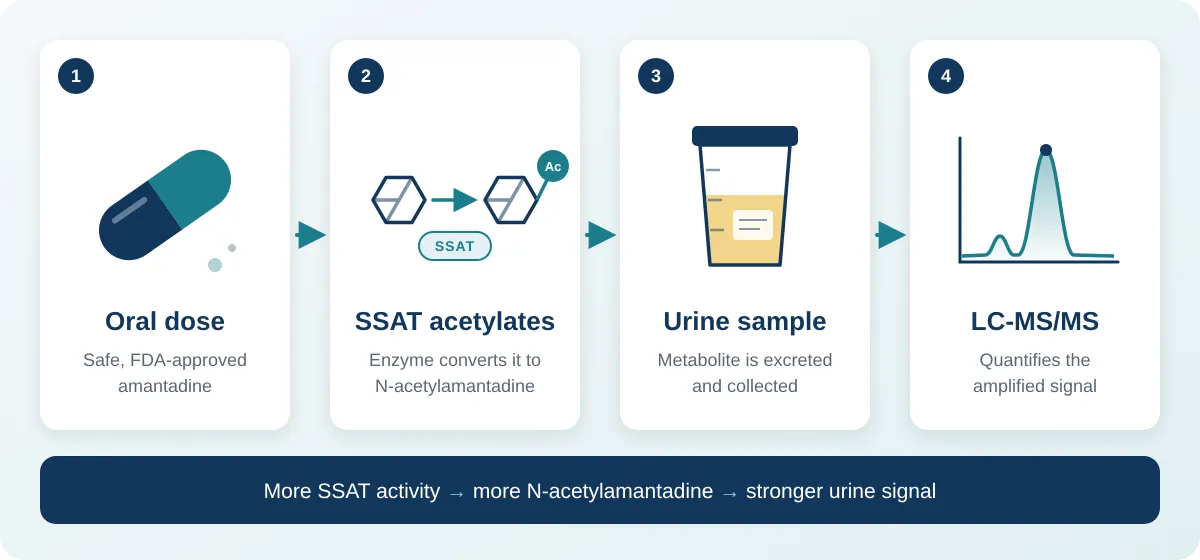
The SSAT1 assay was BioMark’s original liquid biopsy technology and established the metabolomic science later scaled into the company’s flagship Comprehensive Metabolomics Panel. Patients take a simple, safe oral dose of the FDA-approved drug amantadine, which SSAT converts into N-acetylamantadine — measured in urine by LC-MS/MS. Elevated levels provide an amplified, objective signal of SSAT activity.
Now repositioned: The assay’s primary clinical focus has shifted to glioblastoma (GBM) treatment response assessment and pseudoprogression differentiation, alongside its established role as a multi-cancer surveillance tool.
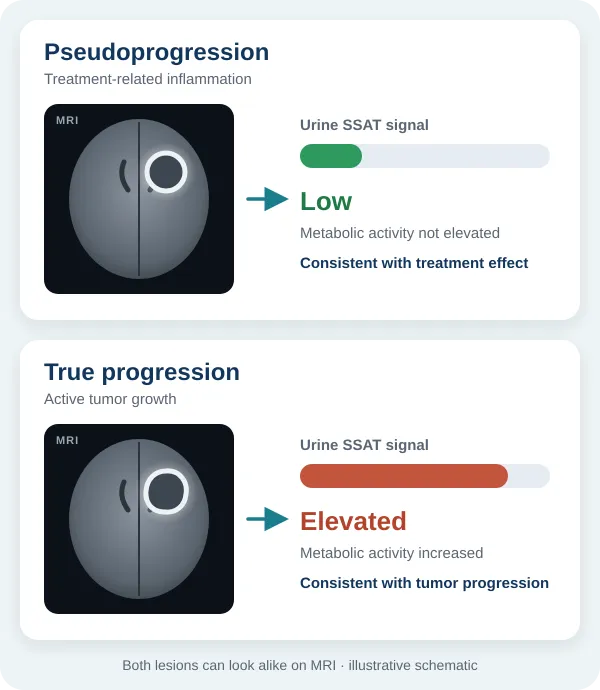
Up to 20–30% of glioblastoma patients undergoing chemoradiotherapy develop pseudoprogression — a treatment-related inflammatory change on MRI that closely mimics true tumor growth. Conventional imaging alone often cannot reliably distinguish the two within the critical early follow-up window, risking premature treatment changes.
The legacy SSAT1 assay offers an objective, urine-based biochemical signal that tracks real metabolic tumor activity rather than relying on structural imaging alone — helping clinicians differentiate genuine progression from pseudoprogression and monitor how well treatment is working over time.
Illustrative schematic. Similar-looking MRI lesions, different metabolic signals.
SSAT enzyme elevation has been documented across numerous cancer types — including lung, breast, prostate, gastrointestinal, and head and neck cancers — supporting its use as a broad surveillance biomarker rather than a single-cancer diagnostic. This makes the assay well suited for monitoring high-risk or previously treated patients over time.
Helps distinguish true tumor progression from pseudoprogression during and after chemoradiotherapy.
SSAT elevation is documented in lung, breast, prostate, GI, and head and neck cancers.
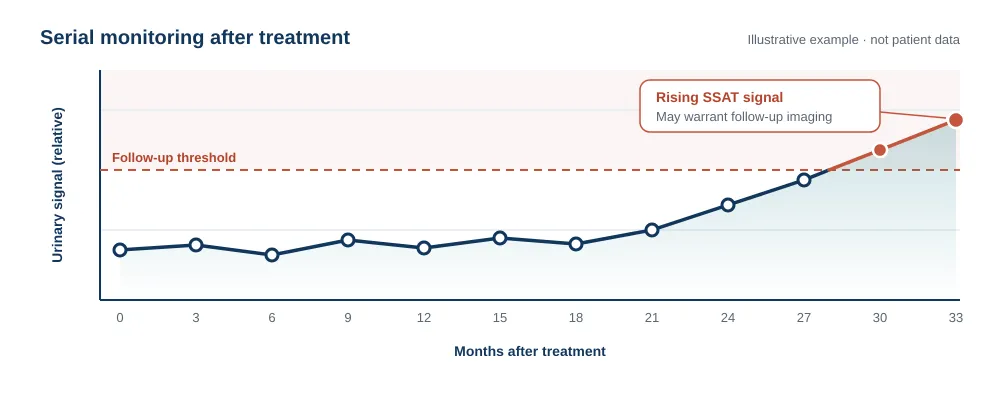
Detects rising SSAT activity that may signal disease return in previously treated patients.
Established the metabolomic science later scaled into BioMark's flagship Comprehensive Metabolomics Panel.
The flagship Comprehensive Metabolomics Panel (CMP), a liquid biopsy-based test with AI-driven analysis, is on track for commercial launch following ISO 15189 accreditation.