CSE: BUX | OTCQB: BMKDF | FSE: 20B

Publications and Scientific Posters

Peer-Reviewed Publications

BioMark’s metabolomics and AI-driven platform is backed by a growing body of rigorous, peer-reviewed research. Our findings on early-stage lung cancer detection, breast cancer biomarker discovery, and GBM monitoring have been published in leading journals such as Frontiers in Oncology and the International Journal of Molecular Sciences, and presented at major conferences including SABCS, ASCO, and USCAP.

Research Publicatons

SEFA: Semantic Embedding-Based Feature Augmentation of Biomedical Language-Model Embeddings Improves Interpretable Metabolomic Prediction of Lung Cancer

biomedicines - August 18, 2026

SEFA: Semantic Embedding-Based Feature Augmentation of Biomedical Language-Model Embeddings Improves Interpretable Metabolomic Prediction of Lung Cancer

Lung cancer remains the leading cause of cancer mortality worldwide, and outcomes depend strongly on the stage at diagnosis, motivating the search for accurate, minimally invasive biomarkers [1]. Metabolomics, which measures small-molecule end-products of cellular activity, offers a sensitive readout of the metabolic reprogramming that accompanies malignancy and has shown promise for non-invasive lung-cancer detection from blood and other biofluids [2–9].
Read The Publication

Smoking-Stratified Signal Decomposition and Feature Selection for Never-Smoker Cancer Classification in a Combined Lung-Breast Metabolomics Cohort

International Journal of Molecular Sciences - August 17, 2026

Smoking-Stratified Signal Decomposition and Feature Selection for Never-Smoker Cancer Classification in a Combined Lung-Breast Metabolomics Cohort

Cancer metabolomic classifiers trained on mixed-smoking cohorts can absorb tobacco-exposure signal and lose accuracy in never-smokers, a group in which lung adenocarcinoma is often diagnosed. We used a two-stage approach on a shared 129-metabolite panel from a combined lung–breast cancer cohort (n = 1038). Two-way ANOVA with Benjamini–Hochberg correction split the panel into cancer-specific (Signal C), smoking-specific (Signal S), and shared components. Of 129 metabolites, 54 were Signal C and 57 were Signal S, so nearly half of the panel tracked tobacco exposure. Rank aggregation across four feature-selection methods then isolated a 19-metabolite Signal C model, trained with gradient-boosted trees. In never-smokers it reached an out-of-fold AUC of 0.907 (mean fold AUC 0.910) versus an all-metabolite baseline of 0.895, with 85% fewer measurements. The decomposition flags metabolites whose case–control differences are not due to smoking and supports a much smaller panel.
Read The Publication

Translational impact of machine learning-driven predictive modeling with pathway-based plasma metabolomic biomarkers for lung cancer detection

Frontier in Oncology - January 22, 2026

Translational impact of machine learning-driven predictive modeling with pathway-based plasma metabolomic biomarkers for lung cancer detection

Objectives: The detection of lung cancer at its early stages remains essential for better survival outcomes, but current diagnostic approaches show limited sensitivity and often suffer from poor generalizability and a lack of interpretability.
Read The Publication

Early cancer detection using biomarkers could save lives and healthcare system resources

Canadian Securities Exchange Magazine - June 2025

Early cancer detection using biomarkers could save lives and healthcare system resources

BioMark Diagnostics (CSE:BUX) was featured in the June 2025 Canadian Securities Exchange Magazine for its AI-powered metabolomics platform. Using liquid biopsy and graph neural networks on blood metabolites, it enables earlier cancer detection with greater accuracy than CT screening. CEO Rashid Bux highlights the vision for reliable, accessible tests that save lives and resources.
Read The Publication

M-GNN: A Graph Neural Network Framework for Lung Cancer Detection Using Metabolomics and Heterogeneous Graph Modeling

International Journal of Molecular Sciences Special Issue - May 13, 2025

M-GNN: A Graph Neural Network Framework for Lung Cancer Detection Using Metabolomics and Heterogeneous Graph Modeling

M-GNN, a graph neural network using GraphSAGE, improves early lung cancer detection through metabolomics. Trained on 800 plasma samples (586 cases, 214 controls), it achieved 89% accuracy and 0.92 AUC by identifying complex metabolite patterns linked to smoking and metabolic dysregulation — offering a scalable, interpretable alternative to high false-positive CT screening.
Read The Publication

Clinical Validation of Plasma Metabolite Markers for Early Lung Cancer Detection

International Journal of Molecular Sciences Special Issue - May 9, 2025

Clinical Validation of Plasma Metabolite Markers for Early Lung Cancer Detection

This study identified a plasma metabolite panel for early-stage NSCLC using targeted metabolomics on 896 samples. Logistic regression models with ten metabolites achieved AUROC values of 93.6–93.9% for Stage I disease. Incorporating smoking history improved performance, and validation confirmed high sensitivity and specificity.
Read The Publication

Metabolomics-Based Machine Learning Models Accurately Predict Breast Cancer Estrogen Receptor Status

International Journal of Molecular Sciences - December 4, 2024

Metabolomics-Based Machine Learning Models Accurately Predict Breast Cancer Estrogen Receptor Status

Breast cancer is a global concern as a leading cause of death for women. Early and precise diagnosis can be vital in handling the disease efficiently. Breast cancer subtyping based on estrogen receptor (ER) status is crucial for determining prognosis and treatment. This study uses metabolomics data from plasma samples to detect metabolite biomarkers that could distinguish ER￾positive from ER-negative breast cancers in a non-invasive manner. T
Read The Publication

Use of amantadine as substrate for SSAT-1 activity as a reliable clinical diagnostic assay for breast and lung cancer

International Journal of Molecular Sciences - December 4, 2024

Use of amantadine as substrate for SSAT-1 activity as a reliable clinical diagnostic assay for breast and lung cancer

This study describes a novel noninvasive urine test for detecting and screening of breast and lung cancer using a safe and approved drug called amantadine. Higher concentration of the acetylated form of amantadine in the urine are detectable in the urine of both breast and lung cancer patients as compared with healthy adult volunteers. This test is simple and may serve as a useful tool for determining the presence of breast and lung cancer.
Read The Publication

Identification of a Novel Biomarker Panel for Breast Cancer Screening

International Journal of Molecular Sciences - November 4, 2024

Identification of a Novel Biomarker Panel for Breast Cancer Screening

This study used plasma metabolomics and machine learning to distinguish ER-positive from ER-negative breast cancers non-invasively. Data from 188 patients and 73 controls were analyzed with Recursive Feature Elimination and Random Forest, identifying 30 key features that achieved an AUC of 0.95 and 93% accuracy. The results support metabolomics as a promising tool for improving breast cancer subtyping.
Read The Publication

Metabolomic Profiling of Pulmonary Neuroendocrine Neoplasms

International Journal of Molecular Sciences - September 17, 2024

M-GNN: A Graph Neural Network Framework for Lung Cancer Detection Using Metabolomics and Heterogeneous Graph Modeling

M-GNN, a graph neural network using GraphSAGE, improves early lung cancer detection through metabolomics. Trained on 800 plasma samples (586 cases, 214 controls), it achieved 89% accuracy and 0.92 AUC by identifying complex metabolite patterns linked to smoking and metabolic dysregulation — offering a scalable, interpretable alternative to high false-positive CT screening.
Read The Publication

Liquid Biopsy in Lung Cancer Screening: The Contribution of Metabolomics. Results of A Pilot Study

International Journal of Molecular Sciences - September 17, 2024

Liquid Biopsy in Lung Cancer Screening: The Contribution of Metabolomics. Results of A Pilot Study

Metabolomic profiling of the SSAT-1/polyamine pathway identified a 14-metabolite panel that distinguished lung cancer patients from healthy controls with an AUC of 0.97. LC-MS/MS analysis of plasma samples showed strong discriminatory performance. This approach demonstrates potential as a specific diagnostic and treatment monitoring tool for lung cancer.
Read The Publication

Spermidine/Spermine N1-Acetyltransferase 1 (SAT1)—A Potential Gene Target for Selective Sensitization of Glioblastoma Cells Using an Ionizable Lipid Nanoparticle to Deliver siRNA

Special Issue: Novel Techniques and Technology for Treatment of Brain Tumors October 22, 2022

Spermidine/Spermine N1-Acetyltransferase 1 (SAT1)—A Potential Gene Target for Selective Sensitization of Glioblastoma Cells Using an Ionizable Lipid Nanoparticle to Deliver siRNA

LNP-siSAT1, a lipid nanoparticle siRNA delivery system, was developed to knockdown SAT1 in glioblastoma. SAT1 knockdown in GBM cell lines reduced viability by 40% and sensitized cells to radiation and chemotherapy while sparing normal brain cells. Enhanced delivery across a blood-brain barrier model using a cadherin-binding peptide supports LNP-siSAT1 as a promising targeted therapy.
Read The Publication

Metabolomic Profiling for the Early Detection of Lung Cancer

Annals of Oncology - July, 2022

Metabolomic Profiling for the Early Detection of Lung Cancer

Lung cancer has a five-year survival rate of only 18.6%. Survival reaches 56% when detected while localized, yet only 16% of cases are diagnosed at this stage. For distant disease the rate drops to 5%, and over 50% of patients die within one year. Early diagnosis is therefore critical for improving outcomes.
Read The Publication

Versatility of Amantadine and Rimantadine for Detection of Cancer

Noval Approaches in Cancer Study - April 21, 2021

Versatility of Amantadine and Rimantadine for Detection of Cancer

Amantadine and rimantadine serve as substrates for spermidine/spermine N1-acetyltransferase-1 (SSAT-1), an enzyme overexpressed in cancer. Following oral administration, measurement of their acetylated metabolites in urine and plasma by LC-MS/MS provides a non-invasive method to detect elevated SSAT-1 activity. This approach offers potential for cancer detection, treatment monitoring, and recurrence assessment.
Read The Publication

A High-Performing Plasma Metabolite Panel for Early-Stage Lung Cancer Detection

Cancers - March 7, 2020

A High-Performing Plasma Metabolite Panel for Early-Stage Lung Cancer Detection

Targeted metabolomic profiling of plasma identified five metabolites significantly altered in early-stage NSCLC. Using 156 patient and 60 control samples, predictive models incorporating these biomarkers with clinical data achieved AUC > 0.9 upon validation. This supports a simple, high-performing plasma test for early NSCLC detection.
Read The Publication

Predictive value and clinical significance of increased SSAT-1 activity in healthy adults

Future Science OA - July 1, 2019

Predictive value and clinical significance of increased SSAT-1 activity in healthy adults

This study describes a novel noninvasive urine test for cancer screening using amantadine. Elevated urinary acetylated amantadine was observed in cancer patients and in some healthy volunteers who later exhibited early clinical signs of malignancy. The test may serve as a useful screening tool for high-risk populations.
Read The Publication

Follow-up evaluation of outliers with elevated spermine-spermidine acetyltransferase-1 activity

The 2019 American Society of Clinical Oncology (ASCO) Meeting - May 15, 2019

Follow-up evaluation of outliers with elevated spermine-spermidine acetyltransferase-1 activity

Urinary acetylamantadine excretion identified elevated SSAT-1 activity in healthy volunteers. Clinical follow-up of outliers revealed malignancy, pre-malignant changes, chronic liver disease, and inflammation. Higher activity in a carcinogen-exposed cohort supports SSAT-1 as an early detection marker.
Read The Publication

Spermidine/spermine N1-acetyltransferase-1 as a diagnostic biomarker in human cancer

Future Science OA - September 10, 2018

Spermidine/spermine N1-acetyltransferase-1 as a diagnostic biomarker in human cancer

Amantadine was evaluated as a tracking agent for spermidine/spermine N1-acetyltransferase-1 (SSAT-1), an enzyme overproduced by cancer cells. Elevated urinary acetylated amantadine levels were detected in cancer patients, supporting its use as a noninvasive screening tool. SSAT-1 measurement in tumor tissue may additionally assist in pathological assessment of malignancy.
Read The Publication

Scientific Posters

Illustrated Research

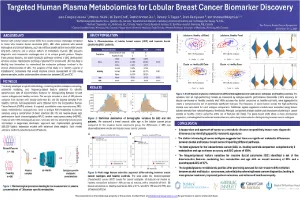
Targeted Human Plasma Metabolomics for Lobular Breast Cancer Biomarker Discovery - SABCS2024

Women with lobular breast cancer (LBC) face several unique challenges compared to those with invasive ductal carcinoma (IDC). LBC often presents with several histological and clinical features, such as a diffuse growth pattern and exhibit poorer long-term outcome and a unique pattern of metastasis. Overall, LBC presents diagnostic and therapeutic challenges due to its unique growth pattern. Despite these unique features, the exact metabolic pathways involved in LBC development remains unclear. Metabolomic profiling of plasma from women with LBC may help to identify new biomarkers to understand the  molecular pathways involved in the clinical characteristics of LBC. The purpose of this study is to identify a panel of metabolomic biomarkers that would improve clinical assessment of LBC using plasma samples, and to understand the intersection between LBC and IDC.

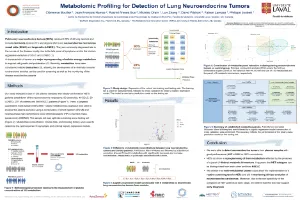
Metabolomic Profiling for Pulmonary Neuroendocrine Tumors

Pulmonary neuroendocrine tumors (NETs) represent 20% of all lung cancers and include carcinoids (typical (TC) and atypical (AC)) and neuroendocrine carcinomas (small cells (SCLC) and large cells (LCNEC)). They are commonly diagnosed late in the course of the disease mostly due to the late onset of symptoms and/or the intrinsic aggressive evolution of SCLC and LCNEC (1). A characteristic of cancer is a major reprogramming of cellular energy metabolism to support cell growth and proliferation (2). Recently, metabolites have been considered reliable biomarkers (3), allowing the development of a minimally invasive routine blood test that can be used for screening as well as the monitoring of the disease evolution for patients.

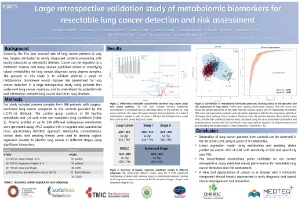
Large retrospective validation study of metabolomic biomarkers for resectable lung cancer detection and risk assessment

Currently, the five-year survival rate of lung cancer patients is very low, largely attributed to newly diagnosed patients presenting with locally advanced or metastatic disease. Cancer can be regarded as a metabolic disease and many studies published aimed at identifying robust metabolites for lung cancer diagnosis using plasma samples. The purpose of this study is to validate whether a panel of metabolomic biomarkers would improve risk assessment for lung cancer detection in a large retrospective study using patients that underwent lung cancer resection, and to understand the potential role and intersection between lung cancer and other lung diseases.

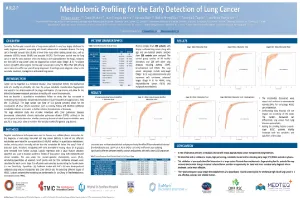
Metabolomic Profiling for the Early Detection of Lung Cancer

Currently, the five-year survival rate of lung cancer patients is very low, largely attributed to newly diagnosed patients presenting with locally advanced or metastatic disease. The lung cancer five-year survival rate (18.6%) is lower than many other leading cancer sites, such as colorectal (64.5%), breast (89.6%) and prostate (98.2%). The five-year survival rate for lung cancer is 56% for cases detected when the disease is still localized (within the lungs). However, only 16% of lung cancer cases are diagnosed at an early stage. For distant tumors (spread to other organs) the five-year survival rate is only 5%. More than 50% of lung cancer cases die within one year of being diagnosed. Accordingly, early diagnosis is key to the successful treatment, management and care of lung cancer. Read the full report.

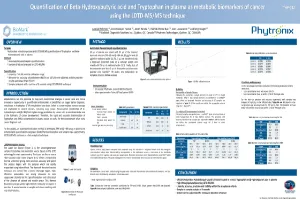
Beta-Hydroxybutyric Acid and Tryptophan Poster ASM2022

Metabolomics has the potential to map early biochemical changes in cancer cells and hence provides an opportunity to quantify cancer biomarkers in blood that can trigger earlier diagnosis. Imbalances in tryptophan (TRP) metabolism have been linked to cancer-related immune escape and implicated in several cancers, including lung cancer. Accumulated metabolites of β-hydroxybutyric acid (β-HBA) from higher energy production by cancer cells is considered to be one of the hallmarks of cancer development. Therefore, the rapid and accurate determination of Tryptophan and β-HBA concentration in plasma would be useful for the development of an early cancer diagnosis tool.

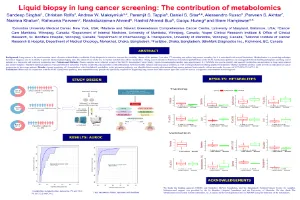
Liquid Biopsy in Lung Cancer Screening

Lung cancer is the most common cause of cancer-related deaths worldwide. Early diagnosis is crucial to increase the curability chance of the patients. Low dose CT screening can reduce lung cancer mortality, but it is associated with several limitations. Metabolomics is a promising technique for cancer diagnosis due to its ability to provide chemical phenotyping data. The intent of our study was to explore metabolomic effects and profiles of lung cancer patients to determine if metabolic perturbations in the SSAT-1/polyamine pathway can distinguish between healthy participants and lung cancer patients as a diagnostic and treatment monitoring tool.

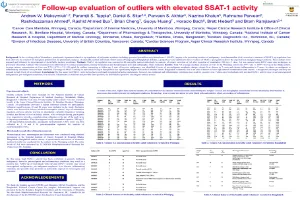
Follow-up Evaluation of Outliers with Elevated SSAT-1 Activity

In the evolving role of biomarkers, proteinomic signatures related to up-regulation of polyamine synthesis including spermine/spermidine acetyltransferase-1 (SSAT-1) appear to be promising markers of malignancy. Acetylamantadine (AA) excretion, a measure of SSAT-1 up-regulation, has been shown to be a marker for malignant proliferation. In preliminary analyses of ostensibly normal individuals from Canada (Winnipeg) and Bangladesh (Dhaka), a proportion were identified to have evidence of SSAT-1 up-regulation above the expected non-malignant range (outliers). These outliers were assessed and followed for development of identifiable medical conditions.

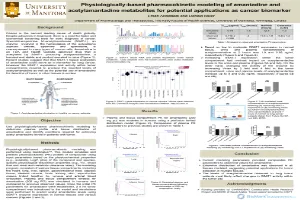
Physiologically-based Pharmacokinetic Modeling of Amantadine and Acetylamantadine Metabolites for Potential Applications as Cancer Biomarker

Cancer is the second leading cause of death globally. Despite advances in treatment, there is a need for faster and economical screening tests for early diagnosis of cancer. Spermidine/spermine N1 -acetyltransferase (SSAT-1), an enzyme involved in the homeostasis of the polycationic aliphatic amines, spermine and spermidine, is overexpressed in many types of cancer cells. Amantadine is an FDA and Health Canada approved drug that is acetylated by SSAT-1 producing acetylamantadine, a terminal and stable end product excreted in urine. Recent studies suggest that that SSAT-1 based acetylation of amantadine could serve as a biomarker for lung cancer. However the SSAT-1 expression and activity within tumor compartments required to produce the reported levels of acetylamantadine as well as the potential use of amantadine for detection of tumor in other tissues is unclear.

Sign up for the latest BioMark news